by Emmanuel Emmanuel

What Is Instrument Calibration?

Every engineer, quality manager, or safety officer has encountered the word ‘calibration.’ It appears on stickers affixed to test equipment, in compliance audits, and in purchase orders. But what does calibration actually mean—and why should your business care?
This guide breaks down the concept of instrument calibration from the ground up: what it is, how it works, who needs it, and what happens when you skip it. Whether you’re new to the subject or refreshing your knowledge before an audit, this is your starting point.
What Is Instrument Calibration?
Instrument calibration is the process of comparing a measurement device’s output against a known reference standard—and adjusting the device so that its readings fall within an accepted level of accuracy. In simpler terms: you check whether a tool is measuring correctly, and if it isn’t, you bring it back into alignment.
A pressure gauge, for example, might read 100 PSI when the actual pressure is 103 PSI. That three-unit error seems small, but in a chemical plant or oil refinery, it could mean the difference between safe operation and a catastrophic event. Calibration catches these drifts before they cause problems.
The reference standard used during calibration is itself traceable—through an unbroken chain of comparisons—back to national or international measurement standards maintained by bodies like the National Institute of Standards and Technology (NIST).
Why Do Instruments Go Out of Calibration?
Equipment doesn’t stay accurate forever. Several factors cause drift over time:
• Mechanical wear and tear — moving parts, springs, and contacts degrade with use.
• Environmental exposure — heat, humidity, vibration, and corrosive atmospheres all affect sensor performance.
• Shock and overload — dropping a tool or exposing it to readings beyond its range can instantly shift calibration.
• Aging components — electronic components change characteristics as they age.
• Contamination — dust, moisture, or chemical residues can coat sensors and alter readings.
For instruments used in the field—as is common in Gulf Coast industries like oil and gas, petrochemical, and power generation—these stressors are a daily reality. Regular calibration is not optional; it’s operationally essential.
How Does the Calibration Process Work?
Step 1: As-Found Measurement
Before any adjustment is made, a technician records the instrument’s current readings across its operating range and compares them against the reference standard. This is the ‘as-found’ data—it documents whether the instrument was in or out of tolerance before calibration began.
Step 2: Adjustment
If the instrument is out of tolerance, the technician makes adjustments—mechanical, electronic, or software-based—to bring its readings into alignment with the reference standard.
Step 3: As-Left Measurement
After adjustment, the technician records measurements again. This ‘as-left’ data confirms the instrument is now within tolerance. Both datasets are documented on the calibration certificate.
Step 4: Certification and Documentation
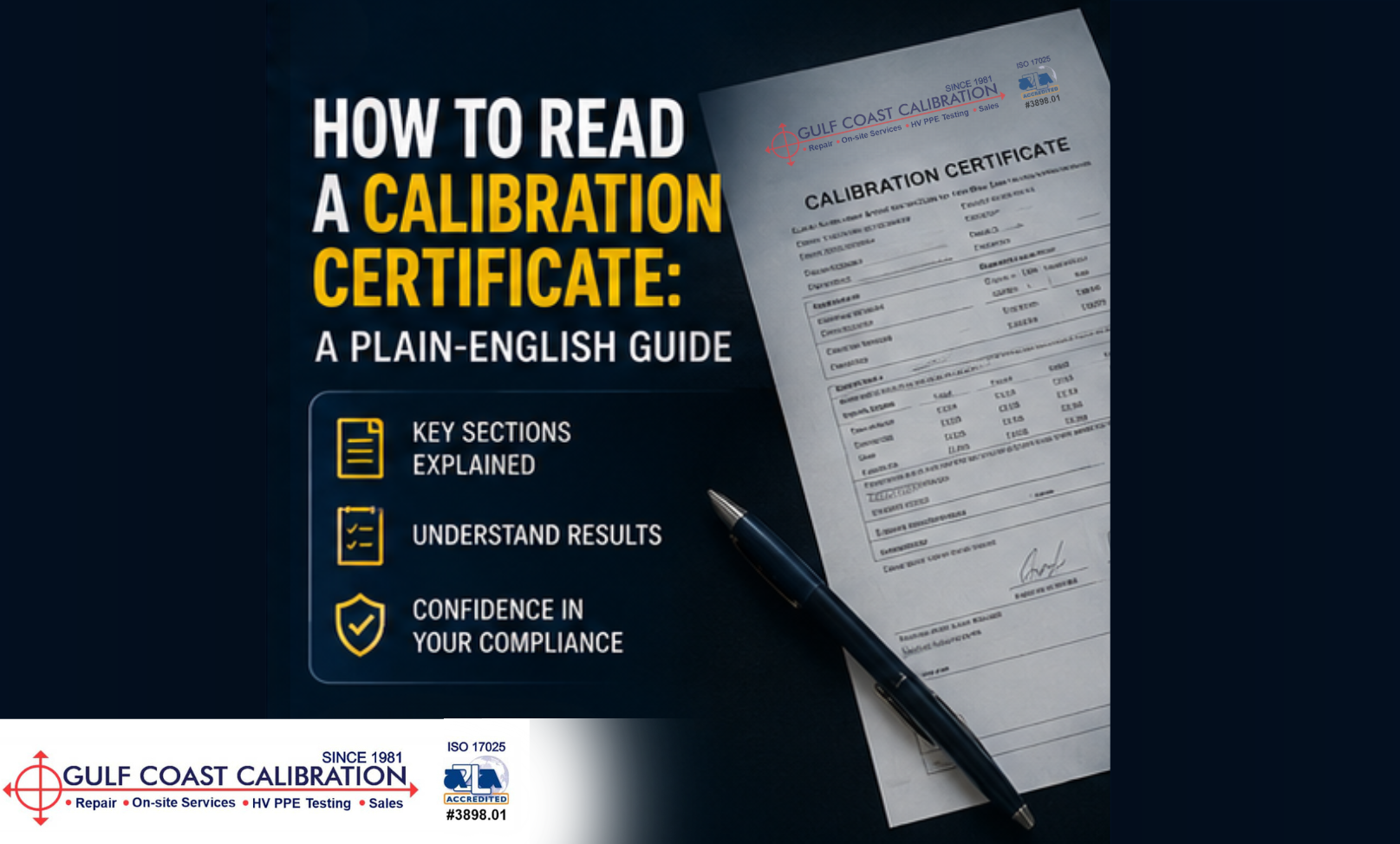
A calibration certificate is issued. It details the instrument’s identification, the reference standards used, the as-found and as-left readings, and the date of the next recommended calibration. Accredited labs like Gulf Coast Calibration store these certificates electronically for easy retrieval during audits.
What Are Calibration Standards?
Calibration is governed by internationally recognized standards that define how it must be performed and documented. The most important is ISO/IEC 17025, the international standard for calibration and testing laboratory competence. Labs accredited to ISO 17025 by bodies such as the American Association for Laboratory Accreditation (A2LA) have demonstrated through rigorous third-party assessment that their methods, equipment, and personnel meet the highest benchmarks.
Gulf Coast Calibration holds A2LA accreditation, which means every calibration we perform is backed by an externally audited quality system—not just an internal promise.
Who Needs Calibration Services?
The short answer: any industry that makes measurements that affect safety, quality, or compliance. Practically speaking, that includes:
• Oil and gas — pressure, temperature, and flow instruments in refineries and pipelines.
• Petrochemical and chemical manufacturing — process control instruments.
• Power generation and electrical utilities — electrical test equipment, torque tools.
• Aerospace and defense — dimensional and precision measurement tools.
• Healthcare and biomedical — medical devices and diagnostic equipment.
• Construction and manufacturing — dimensional tools, torque wrenches.
If your team measures anything—and acts on those measurements—you need calibration.
What Happens If You Skip Calibration?
The consequences of using uncalibrated equipment range from inconvenient to catastrophic:
• Failed audits and regulatory non-compliance — OSHA, ISO, and industry-specific regulations often mandate calibrated equipment.
• Product defects — inaccurate measurements in manufacturing lead to parts that don’t meet tolerances.
• Safety incidents — instruments that misread pressure, temperature, or gas concentrations put workers at risk.
• Financial liability — equipment failures caused by uncalibrated tools can expose companies to lawsuits and settlements.
Beyond legal and financial risk, uncalibrated equipment simply undermines your ability to trust your own data—which defeats the purpose of having instruments in the first place.
Frequently Asked Questions
What’s the difference between calibration and verification?
Verification confirms that an instrument meets its stated specification without making any adjustments. Calibration goes further—it measures, adjusts if necessary, and documents the results. Most compliance frameworks require calibration, not just verification.
Is calibration the same as repair?
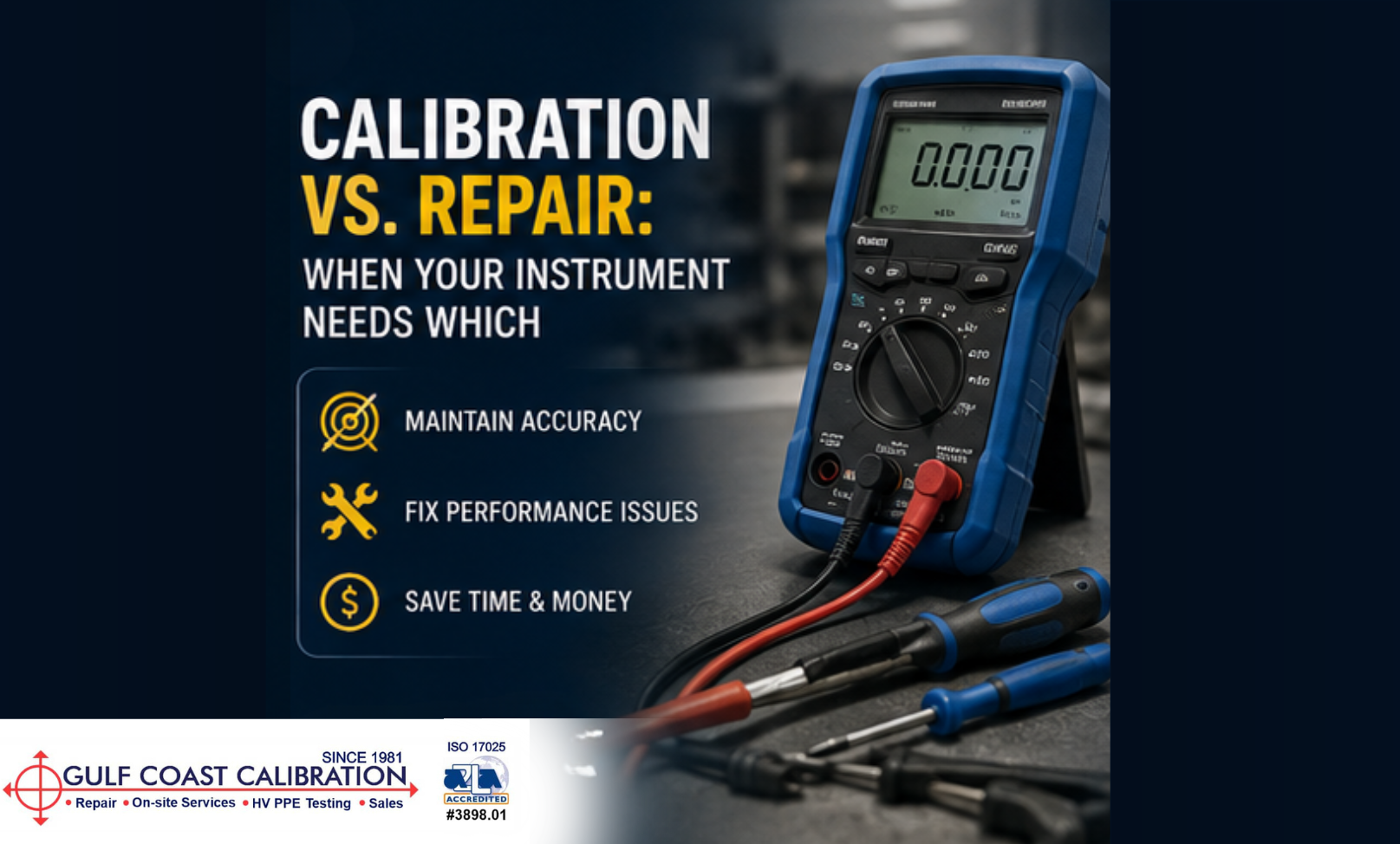
No. Repair fixes a broken instrument; calibration confirms and adjusts accuracy. Sometimes a device needs both—if calibration reveals a fault that can’t be corrected by adjustment alone, repair is the next step. Gulf Coast Calibration’s Houston Repair Center handles both.
How long does calibration take?
It depends on the instrument type and the number of devices. Gulf Coast Calibration offers expedited service that dramatically reduces turnaround time for priority equipment.
Do I get a certificate after calibration?
Yes. Every calibrated instrument receives a certificate documenting the process, reference standards, and results. Gulf Coast Calibration stores certificates digitally in our CAMS platform for at least three years.
Internal Links
• Learn about our Pressure Gauge Calibration Services
• Explore our Electrical Tool Calibration capabilities
• Find out how On-Site Calibration works
• Read about our A2LA Accreditation
→ Need reliable instrument calibration for your team? Request a free quote from Gulf Coast Calibration today — (713) 944-3139 or visit gulfcoastcalibration.com.

Request for Calibration Quote

Request for PPE/Glove Testing Quote

by Emmanuel Emmanuel

Top 10 Tools That Require Regular Calibration

Accurate measurements are the backbone of safe, efficient, and compliant industrial operations. Whether you’re working in oil & gas, manufacturing, or energy, poorly calibrated instruments can lead to costly errors, safety risks, and failed inspections.

At Gulf Coast Calibration, maintaining precision isn’t optional—it’s essential. Below are the top 10 tools that require regular calibration and why keeping them accurate protects your operations.

1. Multimeters

Multimeters are widely used to measure voltage, current, and resistance in electrical systems.

Why calibration matters:

Ensures safe electrical troubleshooting
Prevents incorrect readings that could damage equipment
Supports compliance with safety standards

Recommended frequency: Every 6–12 months

2. Pressure Gauges

Pressure gauges are critical in industries like oil & gas, HVAC, and manufacturing.

Why calibration matters:

Prevents overpressure hazards
Maintains system efficiency
Ensures compliance with regulatory standards

Common issue: Drift due to constant pressure exposure

3. Torque Wrenches

Torque tools ensure bolts are tightened to exact specifications.

Why calibration matters:

Prevents mechanical failure
Ensures structural integrity
Critical in automotive and aerospace applications

Risk of neglect: Under- or over-tightening can cause catastrophic failures

4. Thermometers & Temperature Sensors

This includes thermocouples, RTDs, and infrared thermometers.

Why calibration matters:

Maintains product quality
Ensures process consistency
Essential in food, pharma, and manufacturing

Environmental factors: Heat, humidity, and wear can affect readings

5. Flow Meters

Flow meters measure the rate of liquid or gas movement.

Why calibration matters:

Ensures accurate billing and reporting
Prevents process inefficiencies
Critical in oil, gas, and water systems
6. Calipers & Micrometers

Used for precise dimensional measurements in manufacturing.

Why calibration matters:

Maintains tight tolerances
Reduces product defects
Ensures quality control

Common issue: Wear and tear affecting measurement accuracy

7. Gas Detectors

Gas monitors detect hazardous gases in industrial environments.

Why calibration matters:

Protects worker safety
Ensures OSHA compliance
Prevents false readings

Important: These should be calibrated more frequently due to safety risks

8. Electrical Test Equipment

Includes insulation testers, clamp meters, and power analyzers.

Why calibration matters:

Ensures accurate diagnostics
Prevents electrical hazards
Maintains compliance
9. Weighing Scales & Balances

Used in labs, production, and shipping.

Why calibration matters:

Ensures accurate measurements
Prevents financial losses
Critical for compliance in regulated industries
10. Data Loggers

Data loggers record environmental conditions like temperature and humidity.

Why calibration matters:

Ensures reliable historical data
Supports audits and compliance
Prevents costly errors in controlled environments
How Often Should You Calibrate?

Calibration frequency depends on:

Manufacturer recommendations
Usage intensity
Environmental conditions
Industry regulations

A general rule: critical instruments should be calibrated at least annually, if not more often.

Why Regular Calibration Is Non-Negotiable

Failing to calibrate your tools can result in:

Safety risks
Equipment damage
Regulatory fines
Production downtime
Loss of customer trust

Regular calibration ensures your tools remain accurate, reliable, and compliant.

Partner with Gulf Coast Calibration

At Gulf Coast Calibration, we provide fast, accurate, and accredited calibration services across a wide range of instruments. Our team helps businesses minimize downtime while maintaining the highest standards of precision.

Ready to ensure your equipment is accurate and compliant?
Contact Gulf Coast Calibration today to schedule your next calibration service.

by Emmanuel Emmanuel

Pressure Gauge Calibration: A Complete Industrial Guide

Pressure measurement sits at the heart of countless industrial processes. Whether you’re managing steam lines in a power plant, monitoring hydraulic systems on heavy equipment, or controlling process pressures in a refinery, the accuracy of your pressure gauges is a direct determinant of both operational efficiency and worker safety.

Yet pressure instruments are among the most commonly neglected when it comes to calibration schedules. This guide covers everything facility managers, instrumentation technicians, and quality professionals need to know about pressure gauge calibration.

Why Pressure Gauge Calibration Is Non-Negotiable

Pressure gauges experience drift for a variety of reasons. The Bourdon tube inside a mechanical gauge—the coiled metal element that translates pressure into pointer movement—fatigues over time. Electronic pressure transducers can drift due to temperature cycling, vibration, and component aging.

A gauge that reads 5% high might not seem like a crisis until you consider what that means in practice: a process operating at 500 PSI might actually be running at 475 PSI, causing yield loss, or at 525 PSI, moving into overpressure territory. In chemical processing, either scenario carries serious consequences.

OSHA’s Process Safety Management (PSM) regulations explicitly require that instruments used in covered processes be maintained and verified for accuracy. For companies operating under PSM, un-calibrated pressure gauges aren’t just a quality issue—they’re a regulatory violation.

Types of Pressure Instruments That Require Calibration

Analog Pressure Gauges

The classic Bourdon tube gauge—ubiquitous in industrial environments. These are mechanical devices and are susceptible to fatigue, over-pressurization, vibration damage, and corrosion. They should typically be calibrated annually, or more frequently in demanding service conditions.

Digital Pressure Gauges

Digital gauges use electronic pressure sensors and display results on a digital readout. They generally offer higher accuracy than analog gauges and may include data logging capability, but still require periodic calibration to ensure the sensor remains accurate.

Pressure Transducers and Transmitters

These convert pressure into an electrical signal (typically 4–20 mA or 0–10V) and are used in process control systems. Calibration involves verifying both the sensor’s pressure response and the signal output. Loop calibration—verifying the entire signal chain from sensor to indicator—is often required.

Vacuum Gauges

Instruments used to measure pressures below atmospheric, such as in vacuum systems and distillation columns. Calibration involves special reference standards capable of generating and measuring sub-atmospheric pressures accurately.

Differential Pressure Instruments

These measure the difference between two pressure points, commonly used for flow measurement, level measurement, and filter monitoring. They require calibration at multiple pressure differentials across their operating range.

The Pressure Gauge Calibration Process

Reference Standard Setup

Calibration requires a reference standard with significantly higher accuracy than the gauge being calibrated—typically a 4:1 test accuracy ratio (TAR) or better. Gulf Coast Calibration’s laboratory uses environmentally controlled conditions and NIST-traceable standards to ensure this ratio is consistently maintained.

Span and Zero Check

The gauge is checked at multiple points across its range—typically at 0%, 25%, 50%, 75%, and 100% of full scale—in both increasing and decreasing directions to evaluate hysteresis. The zero point and span (full-scale reading) are verified and adjusted as needed.

As-Found and As-Left Documentation

As with all calibrations, the pre-adjustment (as-found) and post-adjustment (as-left) data are recorded. This data is critical for your quality records and for assessing whether the instrument has been drifting over time—helping you refine your calibration interval.

Calibration Intervals for Pressure Instruments

There is no single universal interval that fits every pressure gauge. The appropriate frequency depends on:

  • Service conditions — harsh environments with vibration, temperature extremes, or corrosive media demand more frequent calibration.
  • Measurement criticality — gauges used in safety-critical or process-control applications should be calibrated more often than those used for general indication.
  • Historical drift data — as-found calibration records show whether a gauge is stable or consistently drifting. Instruments that repeatedly fail calibration should be calibrated more frequently or replaced.
  • Manufacturer recommendations — OEM guidance provides a baseline, though it may not account for your specific service conditions.
  • Regulatory requirements — some industry standards specify minimum calibration frequencies.

Annual calibration is a common starting point for pressure gauges in moderate service, with semi-annual or quarterly cycles for critical or harsh-service applications.

Standards Governing Pressure Calibration

Key standards that reference or govern pressure gauge calibration include ASME B40.100 (pressure gauges), ANSI/ISA-51.1 (process instrumentation terminology), and various API standards relevant to oil and gas operations. ISO/IEC 17025 governs the competence of the calibration laboratory itself.

On-Site vs. Lab Calibration for Pressure Instruments

Gulf Coast Calibration offers both options. Sending instruments to our La Porte, TX laboratory provides access to our full range of environmentally controlled reference standards. For large inventories or instruments difficult to remove from service, our on-site calibration team brings traceable standards to your facility and calibrates instruments in place—minimizing downtime and logistics complexity.

Frequently Asked Questions

Can I calibrate a pressure gauge myself?

Technically yes, if you own a calibrated reference standard and follow a documented procedure. However, for compliance-sensitive applications, calibration must be performed by a competent calibration provider with traceable standards. Self-calibration is generally not acceptable for regulatory compliance or quality system purposes.

What does it mean when a gauge ‘fails’ calibration?

A gauge fails calibration when its readings fall outside the acceptable tolerance at one or more test points. Gulf Coast Calibration will notify you and provide options: adjustment and re-calibration, repair at our Houston Repair Center, or OEM repair if applicable.

Do I need calibration certificates for every gauge?

For any gauge used in a quality-regulated, safety-critical, or compliance-driven application, yes. Certificates document the traceability chain and provide the evidence needed during audits. Gulf Coast Calibration’s CAMS system stores your certificates electronically for at least three years.

→ Gulf Coast Calibration calibrates all types of pressure and vacuum instruments in our environmentally controlled La Porte, TX laboratory. Get a quote

Request for Calibration Quote

Request for PPE/Glove Testing Quote

by Emmanuel Emmanuel

ISO 17025 Calibration: The Standard Every Industry Must Know

If you’ve ever received a calibration certificate and noticed the phrase ‘ISO/IEC 17025 accredited,’ you were looking at the most important quality designation a calibration laboratory can hold. Yet despite its significance, ISO 17025 remains poorly understood outside of quality and metrology circles.

This guide explains what ISO 17025 requires, how it differs from other quality standards like ISO 9001, why it’s the standard your calibration provider should be held to, and what it means when a lab is or isn’t accredited to it.

What Is ISO/IEC 17025?

ISO/IEC 17025 is the international standard published jointly by the International Organization for Standardization (ISO) and the International Electrotechnical Commission (IEC). Its full title is ‘General Requirements for the Competence of Testing and Calibration Laboratories.’

It defines the technical and management requirements that a calibration or testing laboratory must meet to be considered competent capable of producing results that are accurate, repeatable, and traceable to recognized measurement standards. The current version, published in 2017, placed greater emphasis on risk-based thinking, a technology-neutral approach, and flexibility in documenting quality processes.

ISO 17025 vs. ISO 9001: What’s the Difference?

This is one of the most common questions in the quality world, and the distinction matters a great deal when evaluating calibration providers.

ISO 9001 is a quality management system standard. It applies to virtually any organization and focuses on consistent processes, customer satisfaction, and continual improvement. A company with ISO 9001 certification has demonstrated that it manages its processes systematically but ISO 9001 says nothing about whether a lab can actually produce technically accurate measurements.

ISO/IEC 17025 goes further. It incorporates management system requirements similar to ISO 9001 but adds rigorous technical requirements specific to measurement and calibration: personnel competence, method validation, measurement uncertainty, equipment traceability, and result reporting. A calibration certificate issued under ISO 17025 tells you that the lab has demonstrated technical competence not just good administration.

Key Requirements of ISO 17025

Impartiality and Confidentiality

The standard requires labs to identify and manage risks to impartiality including financial, organizational, and personal pressures that might bias results. It also requires robust protection of customer data and calibration results.

Resource Requirements

Labs must ensure personnel are competent and authorized to perform the calibrations they conduct. Equipment used for calibration must itself be calibrated and traceable. Environmental conditions temperature, humidity, vibration must be monitored and controlled where they affect measurement quality.

Process Requirements

Methods used for calibration must be validated or verified before use. Where no standard method exists, labs must document the method they develop. Labs must also evaluate and report measurement uncertainty for all calibrations this is often the most technically demanding aspect of 17025 compliance.

Management System Requirements

Labs must maintain a documented quality management system, conduct internal audits, perform management reviews, and take corrective action when nonconformities are detected. These requirements can be satisfied either by a dedicated quality manual approach or by integration with ISO 9001.

Measurement Traceability Under ISO 17025

One of the most important technical concepts in ISO 17025 is metrological traceability the requirement that every measurement result be connected through an unbroken chain of calibrations to a national or international measurement standard.

For practical purposes, this means the reference standards a calibration lab uses must themselves be calibrated by a higher-level lab whose standards are calibrated in turn, all the way back to national measurement institutes like NIST (in the United States) or equivalent bodies in other countries. This chain is documented on calibration certificates and is essential for demonstrating that your instrument’s accuracy is grounded in a universally recognized measurement basis.

Per the International Laboratory Accreditation Cooperation (ILAC) P14 policy, documented uncertainties are required to continue traceability a requirement that often catches unprepared labs off-guard during audits.

How Accreditation to ISO 17025 Is Achieved

ISO 17025 accreditation is granted by national accreditation bodies in the U.S., primarily A2LA (American Association for Laboratory Accreditation) and NVLAP (National Voluntary Laboratory Accreditation Program). These bodies send technical assessors to evaluate labs against the standard’s requirements through document review, on-site assessment, and witnessed calibrations.

Gulf Coast Calibration holds A2LA accreditation, meaning our quality system, technical personnel, and measurement methods have been independently evaluated and found to meet ISO/IEC 17025 requirements across our scope of calibration services.

Why ISO 17025 Accreditation Matters in the Gulf Coast Region

Industries dominant along the Gulf Coast oil and gas refining, petrochemical manufacturing, LNG, power generation, and offshore operations operate under some of the most demanding safety and quality requirements in the industrial world. Standards including API Q1/Q2, ASME, OSHA Process Safety Management (PSM) regulations, and various EPA air quality programs all reference or require calibrated measurement equipment.

When those instruments are calibrated by an ISO 17025-accredited lab, the calibration certificates carry the evidentiary weight needed to satisfy regulatory auditors, insurance underwriters, and quality program requirements. Calibration from a non-accredited source however well-intentioned may not satisfy those requirements.

Frequently Asked Questions

Can my supplier require ISO 17025-accredited calibration?

Yes. Many Tier 1 industrial manufacturers and engineering firms specify in their quality requirements that calibration suppliers must hold ISO 17025 accreditation. If you’re a supplier or subcontractor, this is a common requirement you may need to satisfy.

What is ILAC, and why does it matter?

The International Laboratory Accreditation Cooperation (ILAC) is a global network of accreditation bodies including A2LA that mutually recognize each other’s accreditation decisions. This means an A2LA-accredited calibration certificate is recognized in dozens of countries, making it valuable for companies with international operations or customers.

Does every calibration need to be ISO 17025 accredited?

Not every calibration scenario legally requires accredited labs, but quality-sensitive calibrations—especially those tied to regulatory compliance, product liability, or safety-critical measurements—should always use an accredited provider. The cost difference is typically modest; the risk difference is substantial.

→ Gulf Coast Calibration is A2LA accredited to ISO/IEC 17025. Request a quote today 

Request for Calibration Quote

Request for PPE/Glove Testing Quote

by Emmanuel Emmanuel

A2LA Accreditation — Why It Matters When Choosing a Calibration Lab

A2LA Accreditation: Why It Matters When Choosing a Calibration Lab
When you hand over critical instruments to a calibration lab, you’re trusting that lab with the accuracy of every measurement your team will make until the next calibration cycle. That’s a significant responsibility and not every lab is equipped to carry it.
One of the clearest signals of a lab’s competence and integrity is its accreditation status. Specifically, accreditation by the American Association for Laboratory Accreditation (A2LA) is the gold standard for calibration labs operating in the United States. Gulf Coast Calibration holds A2LA accreditation, and in this article, we explain exactly what that means for you.
What Is A2LA?
The American Association for Laboratory Accreditation (A2LA) is a nonprofit, non-governmental accreditation body that evaluates and formally recognizes the technical competence of testing and calibration laboratories. Founded in 1978, A2LA operates under the international framework defined by ISO/IEC 17025—the globally accepted standard for laboratory competence.
A2LA accreditation is not a simple registration or membership. It requires a rigorous on-site assessment by trained technical assessors who evaluate every aspect of a lab’s operations: its quality management system, its technical personnel, its measurement equipment, its calibration methods, its environmental controls, and its documentation practices.
What Does ISO/IEC 17025 Require?
ISO/IEC 17025 is the backbone of A2LA accreditation. It specifies two broad categories of requirements that labs must meet:
Management Requirements
These address the organizational and administrative side of lab operations: document control, complaint handling, corrective action processes, internal audits, and management reviews. In essence, the lab must demonstrate that it has systematic processes to detect and correct quality problems.
Technical Requirements
These address the scientific side: personnel qualifications, the suitability of measurement methods, the calibration and maintenance of reference standards, measurement uncertainty, and the validity and reporting of results. For a calibration lab, this means every technician must be demonstrably competent, every reference standard must itself be traceable, and every result must be reported with a documented uncertainty budget.
How the A2LA Assessment Process Works
Achieving A2LA accreditation involves a multi-step process that labs must repeat on an ongoing basis—it is not a one-time achievement:
• Application review — the lab submits detailed documentation of its quality system and scope of calibration activities.
• On-site assessment — A2LA technical assessors visit the lab to verify that documented practices match actual operations, and witness live calibrations.
• Corrective action — any deficiencies identified must be resolved before accreditation is granted.
• Surveillance assessments — A2LA conducts follow-up assessments on a defined cycle to ensure ongoing compliance.
This ongoing oversight is what separates accreditation from a simple paper certification. Labs don’t earn A2LA accreditation once and forget about it—they must maintain their standards continuously.
What A2LA Accreditation Means for You as a Customer
Your Calibration Is Defensible
When regulators, customers, or auditors ask whether your instruments are calibrated to traceable, recognized standards, an A2LA-accredited certificate is your answer. It carries internationally recognized weight and satisfies requirements from ISO 9001, ISO 14001, OSHA, API, and a wide range of industry-specific standards.
Your Results Are Traceable
A2LA-accredited labs must maintain an unbroken chain of traceability back to national or international measurement standards. This means every measurement Gulf Coast Calibration makes on your equipment traces back to NIST or equivalent international bodies—your calibration certificate is evidence of that chain.
Your Uncertainty Is Documented
One of the most technically important aspects of ISO 17025 accreditation is the requirement to document measurement uncertainty. Uncertainty tells you how tightly a lab can actually control its measurement process. Accredited labs publish their scope of accreditation including uncertainty values—this lets you verify that the lab can calibrate your instrument to the precision you require.
You’re Protected from Risk
Calibration from a non-accredited lab may satisfy a checkbox but may not hold up under scrutiny. If a safety incident occurs and investigators question whether your instruments were properly calibrated, an A2LA certificate provides documented, third-party-verified assurance that the work was done to a recognized standard.
How to Verify a Lab’s A2LA Accreditation
A2LA maintains a public directory of accredited labs at a2la.org. You can search by lab name, location, or calibration discipline to confirm accreditation status and view the lab’s specific scope of accreditation—the list of measurement parameters and ranges the accreditation covers.
Don’t rely on a lab’s self-reported claims. Verify directly through the A2LA directory before choosing a calibration provider.
Gulf Coast Calibration’s A2LA Accreditation Scope
Gulf Coast Calibration is A2LA accredited for calibration services covering electrical, torque, pressure, temperature, dimensional, and gas monitoring instruments. Our scope covers the measurement ranges and disciplines most commonly required by Gulf Coast industries—oil and gas, petrochemical, power generation, manufacturing, and more.
Our accreditation is backed by our CAMS (Calibration Asset Management System), which stores your certificates electronically for at least three years, making audit preparation straightforward for your quality team.
Frequently Asked Questions
Is A2LA the same as NVLAP?
No—both are accreditation bodies that operate under ISO 17025, but they are separate organizations. The National Voluntary Laboratory Accreditation Program (NVLAP) is managed by NIST and focuses primarily on federal contractor requirements. A2LA is the dominant accreditor for commercial calibration labs and is accepted by a broader range of industries and international frameworks.
Do I need an accredited lab for OSHA compliance?
Many OSHA standards reference calibrated equipment, and some specifically require traceable calibration. While OSHA does not universally mandate A2LA-accredited labs, using an accredited provider is the safest way to demonstrate due diligence in the event of an incident or inspection.
Does accreditation cost more?
Accredited calibration typically costs modestly more than non-accredited services, reflecting the investment labs make in quality systems, assessments, and traceable reference standards. Given the compliance, legal, and safety value of accredited certificates, most quality-conscious companies consider it well worth the difference.
→ Need reliable instrument calibration for your team? Request a free quote from Gulf Coast Calibration today

Request for Calibration Quote

Request for PPE/Glove Testing Quote

by Emmanuel Emmanuel

Effect of Temperature and Relative Humidity on Lab Equipments

Temperature and relative humidity are important environmental factors in a laboratory. These variables can have a significant impact on the performance and accuracy of laboratory equipment, resulting in damage, degradation, and malfunctions that can affect test results reproducibility. In this blog post, we’ll look at how temperature and relative humidity affect lab equipment and how to keep optimal conditions for scientific research.

Temperature

Temperature has a variety of effects on the performance and accuracy of laboratory equipment. High temperatures can damage components, increase the risk of overheating, and degrade sample quality. Low temperatures, on the other hand, can cause materials to become brittle, increase viscosity, and impair the performance of electronic components.

The following are some examples of temperature effects on laboratory equipment:

  • Thermal expansion and contraction cause component misalignment or damage.
  • Material property changes that affect measurement accuracy
  • Overheating is more likely, resulting in equipment failure or damage.

It is critical to have a controlled HVAC system that provides a stable temperature range within the laboratory in order to maintain optimal temperature conditions for lab equipment. Temperature monitoring should be done on a regular basis to avoid fluctuations that can affect the accuracy of test results. Additionally, equipment should be calibrated on a regular basis to ensure that it is operating within its optimal temperature range and to prevent damage.

Relative Humidity

Another critical factor influencing lab equipment performance is relative humidity. High humidity can cause corrosion, rust, and equipment component damage. It can also cause moisture buildup, which can lead to the growth of mold and bacteria, lowering the accuracy of test results. Electrostatic discharge can be caused by low humidity, which can damage sensitive electronic equipment.

Some examples of the effects of relative humidity on lab equipment include:

  • Metal component corrosion and rust, affecting performance and accuracy
  • Mold and bacteria growth, affecting the accuracy and reliability of test results
  • Electrostatic discharge can cause sensitive electronic components to fail.

It is critical to have a controlled HVAC system that provides stable humidity levels within the laboratory to maintain optimal relative humidity conditions for lab equipment. Humidity levels should be monitored on a regular basis to avoid fluctuations that can affect the accuracy of test results. Furthermore, equipment should be stored in a dry environment and inspected on a regular basis for signs of corrosion or damage.

Conclusion

Temperature and relative humidity are critical factors influencing lab equipment performance and accuracy. Changes in these variables can result in damage, degradation, and malfunctions, all of which can have an impact on the reproducibility of test results. It is critical to have a controlled HVAC system with regular temperature and humidity monitoring to ensure optimal conditions for scientific research. Regular equipment maintenance and calibration can also help to prevent damage and maintain accuracy. Labs can ensure the quality and reliability of their research results by taking temperature and relative humidity into account.

Call us to discuss your calibration, test or repair needs at:
713.944.3139.

Request for Calibration Quote

Request for PPE/Glove Testing Quote

by Emmanuel Emmanuel

Importance Of Turnaround Times In Calibration Services

Finding the proper Calibration Service Provider has become even more crucial and necessary in an ever-changing environment where precision production has become the new normal. How do I know when to calibrate my equipment and devices, and where should I ship them, is a growing concern. This topic becomes much more relevant when you consider the expense of downtime caused by a lack of the equipment and instruments essential for your production process.

Choosing The Best Fit For Your Calibration Requirements

When selecting a Calibration Service Company, it is critical to inquire about their turnaround time for serviced equipment. Many times, you may send your tools and instruments out and wait up to a month or more for them to be returned. When trying to satisfy today’s high production demands, very few manufacturers can remain without a tool or instrument for that length of time.

Importance of Calibrating Tools and Instruments

Today’s industrial demands may force you to postpone your calibration needs or simply not have your equipment and instruments calibrated in order to meet your customers’ demanding timetables. Avoiding calibration periods for precision manufacturing equipment and instruments may be exceedingly expensive, even more so than the downtime associated with sending them out for calibration services. Precision production using out-of-calibration equipment and instruments can result in costly recalls, angry customers, and violations of your quality control processes.

Fast Calibration Service Turnaround Times

Gulf Coast Calibration takes pride in aiming to achieve the quickest lab calibration turnaround times for calibrated devices. We strive for a 5-business-day turnaround time for calibration services after receiving your gages. We frequently surpass this goal with turnaround times as short as three days, and we provide expedited services for an extra fee.

Calibration Services We Offer

  • Local pick-up and delivery services
  • Shipping and receiving services
  • Mobile services for calibration at your facility
  • Customer drop-off and pick-up services

Gulf Coast Calibration | Slider2

When you use our pick-up and delivery services, you can be certain that our professional drivers will keep your equipment secure and orderly. We transport them to our calibration lab and perform the necessary calibration procedures.

When you ship your instrument to us, we receive it and, in many cases, transport it to our accredited lab the same day. In our calibration lab, we then apply the necessary calibration procedure. Typically, the instrument calibration may be done in 1 to 3 business days and returned to our customer via the customer’s preferred delivery method.

Call us to discuss your calibration, test or repair needs at:
713.944.3139.

Request for Calibration Quote
Request for PPE/Glove Testing Quote

by Emmanuel Emmanuel

The Benefits of Regular Calibration

The Benefits of Regular Calibration

Calibration is the process of standardizing or adapting measurement equipment to obtain more accurate results. It is essential to calibrate your equipment regularly to ensure that it is accurate and reliable. In this blog post, we will discuss the benefits of regular calibration.

1. Improved Accuracy

Over time, the accuracy of any measuring device will begin to decline. Typically, this reduction in accuracy is due to normal wear and tear of the various components but may also be due to a harmful environment or mechanical or electrical shock. The attenuation factor of the measurement equipment may vary depending on the environment and type. Due to this decline in measurement accuracy, organizations with measurement equipment prefer to calibrate on a regular basis. By calibrating your equipment, you are giving it the accuracy it needs to do its job properly.

2. Increased Safety

When you use calibration equipment for critical processes, safety is paramount. Even minor inaccuracies can cause the device to malfunction or give false information about how safe something is, leading to injury or damage to the equipment. Regular calibration of the equipment enables accurate measurements to be obtained and hazardous situations to be avoided.

3. Cost Savings

Calibration can help you save money in the long run. By calibrating your equipment regularly, you can identify potential problems before they become major issues. This can help you avoid costly repairs or replacements down the line. Additionally, calibration can help you reduce waste and improve efficiency, which can lead to significant cost savings.

4. Compliance with Regulations

Many industries have regulations that require equipment to be calibrated regularly. By calibrating your equipment, you can ensure that you are in compliance with these regulations. This can help you avoid fines and other penalties.

5. Improved Product Quality

Calibration of the measuring devices ensures that a high level of product quality is maintained. The reason for calibrating the hardware is reliability. When you calibrate your instruments regularly, you know your measuring device is accurate and will read your command according to other measuring devices. Calibration is essential if you care about the accuracy and consistency of your measuring instruments.

In conclusion, regular calibration of your equipment is essential to ensure that it is accurate, reliable, and safe. It can help you save money, improve product quality, and ensure compliance with regulations. If you need help with calibration, Gulf Coast Calibration (GCC) can help. GCC provides calibration services for a wide range of equipment, including electrical, mechanical, and dimensional equipment1

1Gulf Coast Calibration (GCC) provides calibration services for a wide range of equipment, including electrical, mechanical, and dimensional equipment.

Request for Calibration Quote
Request for PPE/Glove Testing Quote

by Emmanuel Emmanuel

How to Ensure the Safety and Accuracy of Your Hot Sticks

Hot Sticks Safety and Accuracy

Hot sticks are essential tools for electric utility workers who perform live-line work on energized high-voltage power lines. They are insulated poles, usually made of fiberglass, that allow workers to operate various devices on the line without exposing themselves to electric shock. However, hot sticks are not immune to damage, wear and tear, or environmental factors that can compromise their insulation and mechanical properties. Therefore, it is crucial to inspect, test, and calibrate your hot sticks regularly to ensure their safety and accuracy.

Inspection

Before using a hot stick, you should always inspect it visually for any signs of damage, such as cracks, chips, dents, burns, or contamination. You should also check the hardware, such as nuts, bolts, clamps, and springs, for any looseness, corrosion, or deformation. If you find any defects, you should not use the hot stick and report it to your supervisor for repair or replacement.

You should also inspect your hot stick after each use and clean it with a mild detergent and water. You should avoid using any solvents, abrasives, or harsh chemicals that can damage the fiberglass or the protective coating. You should also store your hot stick in a dry and cool place, away from direct sunlight, heat sources, or sharp objects.

Testing

In addition to visual inspection, you should also test your hot stick periodically for its electrical and mechanical performance. Electrical testing involves applying a high voltage to the hot stick and measuring the leakage current or the dielectric strength. Mechanical testing involves applying a bending or tensile force to the hot stick and measuring the deflection or the breaking point.

There are different standards and methods for testing hot sticks, depending on the type, length, and application of the tool. For example, ASTM F711 specifies the requirements for hot sticks used in electric power generation, transmission, and distribution. OSHA 1910.269 specifies the safety practices for workers who perform live-line work. You should follow the relevant standards and methods for your hot stick and use the appropriate equipment and procedures for testing.

Calibration

Calibration is the process of comparing the output or the measurement of a hot stick to a known standard and adjusting it if necessary. Calibration ensures that your hot stick is accurate and reliable for its intended use. For example, if you use a hot stick to measure voltage, current, or resistance on a power line, you need to calibrate it against a reference meter or a traceable source.

Calibration should be performed by a qualified and accredited calibration laboratory, such as Gulf Coast Calibration, that has the expertise and the equipment to calibrate your hot stick according to the industry standards and specifications. You should calibrate your hot stick at least once a year or more frequently, depending on the frequency and the severity of use, the environmental conditions, or the manufacturer’s recommendations.

Conclusion

Hot sticks are vital tools for electric utility workers who perform live-line work on energized high-voltage power lines. They provide insulation and mechanical strength to protect workers from electric shock and to operate various devices on the line. However, hot sticks can deteriorate over time and lose their safety and accuracy. Therefore, it is essential to inspect, test, and calibrate your hot sticks regularly to ensure their optimal performance and reliability.

Let Gulf Coast Manage Your Calibration Schedule.

If you need professional and quality calibration services for your hot sticks or other electrical tools, contact Gulf Coast Calibration today. We are an ISO 17025 accredited calibration laboratory that offers a wide range of calibration and testing services for electrical, temperature, pressure, dimensional, and other instruments. We have state-of-the-art equipment and experienced technicians who can calibrate your hot sticks and other tools according to the industry standards and specifications. We also offer fast turnaround times, competitive prices, and excellent customer service. Contact us today and get 10% off your first calibration or testing service with us!

Call us to discuss your calibration, test or repair needs at:
713.944.3139.

Request for Calibration Quote
Request for PPE/Glove Testing Quote

by Emmanuel Emmanuel

The Importance of Calibrating Your Pressure Gauge

In industrial settings, a pressure gauge is one of the most essential instruments used to measure and monitor pressure levels in various applications, from manufacturing and HVAC systems to oil and gas pipelines. Ensuring that your pressure gauge is accurate isn’t just a matter of operational efficiency it’s a critical factor in maintaining safety, regulatory compliance, and cost-effectiveness.

At Gulf Coast Calibration, we specialize in precise calibration services, helping businesses maintain the accuracy of their equipment and ensure optimal performance. In this post, we’ll dive into the importance of calibrating your pressure gauge and the value it brings to your operations.

1. Safety Comes First

Pressure gauges are often used in high-stakes environments where even a small deviation from true pressure readings could lead to dangerous conditions. A miscalibrated gauge might display incorrect information, potentially leading to an unsafe increase in pressure. Regular calibration ensures that readings are accurate, helping prevent incidents like equipment failure, leaks, or even explosions, which can endanger personnel and damage facilities.

2. Maintaining Compliance with Industry Standards

Many industries, including oil and gas, pharmaceuticals, food processing, and manufacturing, must adhere to strict regulatory standards for safety and quality. Regulatory bodies such as OSHA, ISO, and ASME often require routine calibration of pressure gauges as part of compliance protocols. By calibrating your gauges with Gulf Coast Calibration, you can be confident that you meet industry standards and regulatory requirements, avoiding potential fines or operational shutdowns.

3. Ensuring Operational Efficiency

Even a slight inaccuracy in your pressure readings can lead to inefficiencies in your systems. For instance, in manufacturing, incorrect pressure can cause production inconsistencies, resulting in product defects or wasted materials. Regular calibration ensures your gauge is operating precisely as intended, optimizing the efficiency of your processes and minimizing waste. This level of precision is particularly important for industries with tight tolerances or sensitive pressure requirements.

4. Prolonging Equipment Life

When pressure gauges provide accurate readings, systems are less likely to be subjected to stress, overpressure, or misapplication. By keeping pressure levels within their ideal range, you reduce the wear and tear on equipment and prevent premature failures. Investing in regular calibration can ultimately extend the life of your equipment, reducing repair and replacement costs over time.

5. Cost Savings in the Long Run

At first glance, calibration might seem like an added expense, but in the long run, it actually saves money. Accurate gauges reduce the risk of accidents, operational inefficiencies, and equipment damage all of which can be costly to address. By regularly calibrating your pressure gauges, you avoid these unexpected expenses and keep operations running smoothly

6. Building Trust with Your Customers

In industries where products are directly impacted by pressure (such as in pharmaceuticals, food and beverage, or chemical manufacturing), an accurate pressure gauge contributes to consistent quality. When your customers know that you prioritize precision and safety by calibrating your equipment regularly, you build trust in your brand and your products.

When Should You Calibrate Your Pressure Gauge?

The frequency of calibration depends on a few factors: the industry standards in your field, the sensitivity and type of gauge, and environmental conditions. At Gulf Coast Calibration, we recommend that gauges be calibrated at least annually, but high-precision or high-use applications might require calibration every six months or even quarterly.

Why Choose Gulf Coast Calibration?

At Gulf Coast Calibration, we understand the unique demands of pressure gauge calibration. Our team of experts brings precision and reliability to every calibration project, ensuring that your gauges are accurate and dependable. We offer on-site calibration services tailored to fit your schedule, minimizing downtime while maintaining accuracy.

Call us to discuss your calibration, test or repair needs at:
713.944.3139.

Request for Calibration Quote
Request for PPE/Glove Testing Quote